Push Subscriptions in an API on Exchange Web Services which allows a user account to subscribe to push notification
An operator could leverage this feature in order to force an authentication over HTTP to any HTTP server controlled by himself, being able to cross-relay this authentication to a DC’s LDAP Server
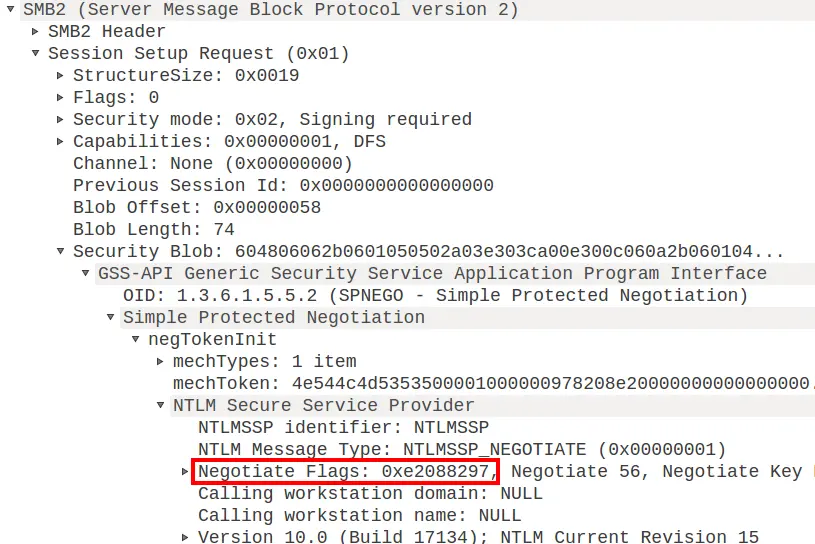
This NTLM Relay over HTTP to LDAP is achieved because of HTTP Windows clients do not enable the NTLMSSP_NEGOTIATE_SIGN flag, unlike SMB Clients
This is why it is not possible to cross-relay an authentication over SMB to an LDAP server. Windows SMB clients always enable that integrity flag and the DCs’ LDAP servers are set to ensure integrity session if the client supports and enables it
Zoom in
However, as mentioned, if an operator manages to coerce an Exchange Server, by leveraging the Push Subscription feature, and relays the received authentication over HTTP to the DC’s LDAP Server, he can either take over the entire domain by leveraging the Exchange Windows Permissions group DACL (WriteDACL) to grant DCSync rights to a controlled account by himself or compromise the Exchange Server itself by performing a RBCD attack
First, we need a domain user account which has a mailbox associated
Then, we authenticate as this user account to the Exchange Web Service and leverage the Push Subscription feature to coerce the server and force it to authenticate to an HTTP server controlled by us
Once we do this, we will receive an authentication over HTTP, that we can relay to somewhere in order to achieve any type of compromise
In this case, we can differentiate between two distinct types of abuse, one related to compromise the Exchange Server itself and the other intented to take over the entire domain
For the former, we can enable RBCD on the Exchange Server object and leverage a controlled computer account to carry out the attack. For the latter, we will grant DCSync rights to a controlled user account by abusing the inherent rights of the Windows Exchange Permissions group over the domain object
#1 - NTLM Relay over HTTP to LDAP (DC) + RBCD = Exchange Server Compromise
In first place, we have to set up an HTTP Server to handle the HTTP request and answer with an HTTP response containing a WWW-Authenticate header to force the authentication from the client
Once we receive that authentication over HTTP, we can cross-relay it to the DC LDAP server and authenticate as the Exchange Server computer account
Take into account that a computer account can modify its own ms-DS-Allowed-To-Act-On-Behalf-Of-Other-Identity attribute. Therefore, after the successful LDAP bind as the computer account, an operator could add the SID of another computer account under his control as the value of this attribute
If we have not compromised a domain computer account yet, but we have valid credentials for a user account, we could leverage the ms-DS-MachineAccountQuota attribute in order to add a computer account to the domain, as this attribute allows any domain user account to add up to ten computer account to the domain
We can check the ms-DS-MachineAcountQuota domain attribute and add a computer account to the domain as follows
Then, we have to use a tool that allow us to relay the received authentication to the DC’s LDAP Server and populate the RBCD attribute with the SID of the controlled computer account
Now, we can check if the ms-DS-AllowedToActOnBehalfOfOtherIdentity attribute of the Exchange Server is populated with some data such as the SID of the computer account under our control
Once the above is done, a Full S4U must be performed from the controlled computer account in order to achieve our goal
To do so, first, we have to carry out a ServiceForUserToSelf (S4U2Self) from the computer account to itself on behalf of a certain user
In this case, the user must be a privileged one, such as the Administrator user, in order to be able to access or dump sensitive data from the Exchange Server
When performing a S4U2Self, the kerberos client initializes a TGS Exchange with the Ticket Granting Service of the KDC. It authenticates as a service account, in this case the computer account we control, in order to request a Service Ticket for itself in behalf of any domain user account
After this, we must continue with a ServiceForUserToProxy (S4U2Proxy) from the computer account to the Exchange Server on behalf of the previous user
For this action, the kerberos client initializes another TGS Exchange to the KDC’s TGS. But, this time, to generate the TGS_REQ, it provides the controlled computer account Ticket Granting Ticket (TGT) as the main ticket and the S4U2Self service ticket as additional ticket
Then, the TGS verifies the authenticity of the client by decrypting the computer account TGT with a key derived from the KRBTGT account password and the authenticator. Moreover, it looks for the SID of the computer account in the Exchange Server ms-DS-AllowedToActOnBehalfOfOtherIdentity attribute
If everything is correct, it will generate the Service Ticket for the requested SPN, related to the Exchange Server, on behalf of the principal specified in the ClientName field of the additional ticket (i.e. S4U2Self Service Ticket)
Thus, before proceeding with all this, we should list the Service Principal Names (SPNs) registered for the Exchange Server computer account as we must specify a SPN during the process
Next, proceed with the Full S4U authenticating as the controlled computer account to request a Service Ticket on behalf of the domain Administrator user to the Exchange Server
We have now a Service Ticket issued for a domain privileged user to authenticate to the Exchange Web Server
According to the SPN requested during the S4U2Proxy, we can carry out a bunch of actions such as a DCSync or get a interactive shell via SMB or WinRM and so on
Let’s suppose that we requested a service Ticket for the CIFS/SMB server. If so, we could perform either a DCSync
From there, we could grab the NT Hash or AES Keys of the KRBTGT built-in account to perform a Golden Ticket or start a pillaging process on the victim looking for leaked credentials or other sensitive information
#2 - NTLM Relay over HTTP to LDAP (DC) + Exchange-related DACL Abuse + DCSync = Domain Takeover
In the other hand, we can directly aim to take over the entire domain by relaying the received authentication over HTTP to the DC’s LDAP Server in the same way, but abusing the Exchange Windows Permissions group rights over the domain to grant DCSync rights instead of leveraging RBCD
So, simply set up an HTTP Server in order to force the authentication from the client by using the WWW-Authenticate header within the HTTP Response. After that, the client will send another HTTP Request, but this time with the Authorization header set, containing a krb5blob wrapped in a GSSAPI structure
Once we receive the given authentication over HTTP, we will cross-relay it to the DC in order to grant DCSync rights to a domain user account under our control
If everything has gone well, the controlled user should have the relevant DCSync rights, namely, DS-Replication-Get-Changes and DS-Replication-Get-Changes-All
Therefore, we could extract all sensitive information for user KRBTGT and then, carry out a Golden Ticket attack to ensure persistence across the domain